
Psychosocial Hazards in Queensland: What Employers Actually Have to Do
Most Queensland businesses know they have to manage physical safety. Far fewer have done anything about psychosocial hazards — the parts of work that can harm mental health. That gap is now a compliance problem, because in Queensland this is no longer optional guidance.
The Managing the risk of psychosocial hazards at work Code of Practice 2022 commenced on 1 April 2023, alongside the Work Health and Safety (Psychosocial Risks) Amendment Regulation 2022, which makes the duty to manage psychosocial risks explicit in the WHS Regulation. And in Queensland, codes of practice carry real legal weight: under section 26A of the WHS Act, a business must either comply with an approved code, or manage the risks in a way that achieves an equivalent or higher standard. You can't simply ignore it. The Code applies to workplaces covered by the WHS Act - Queensland mining and resources workplaces sit under a separate regime administered by Resources Safety & Health Queensland - but for almost every other Queensland employer, this obligation is active, not passive.

What a psychosocial hazard is
A psychosocial hazard is anything in the way work is designed, organised, managed or carried out that can cause psychological harm - and sometimes physical harm too. Some hazards do their damage slowly, building up over months. Others, like a single traumatic event, can cause harm immediately.
This is not about being responsible for everything happening in someone’s life. It is about the work itself - the demands, the environment, the relationships and the way the job is run.
The psychosocial hazards the Code expects you to consider
The Code sets out a list of common psychosocial hazards. These are the ones to look for in your own workplace:
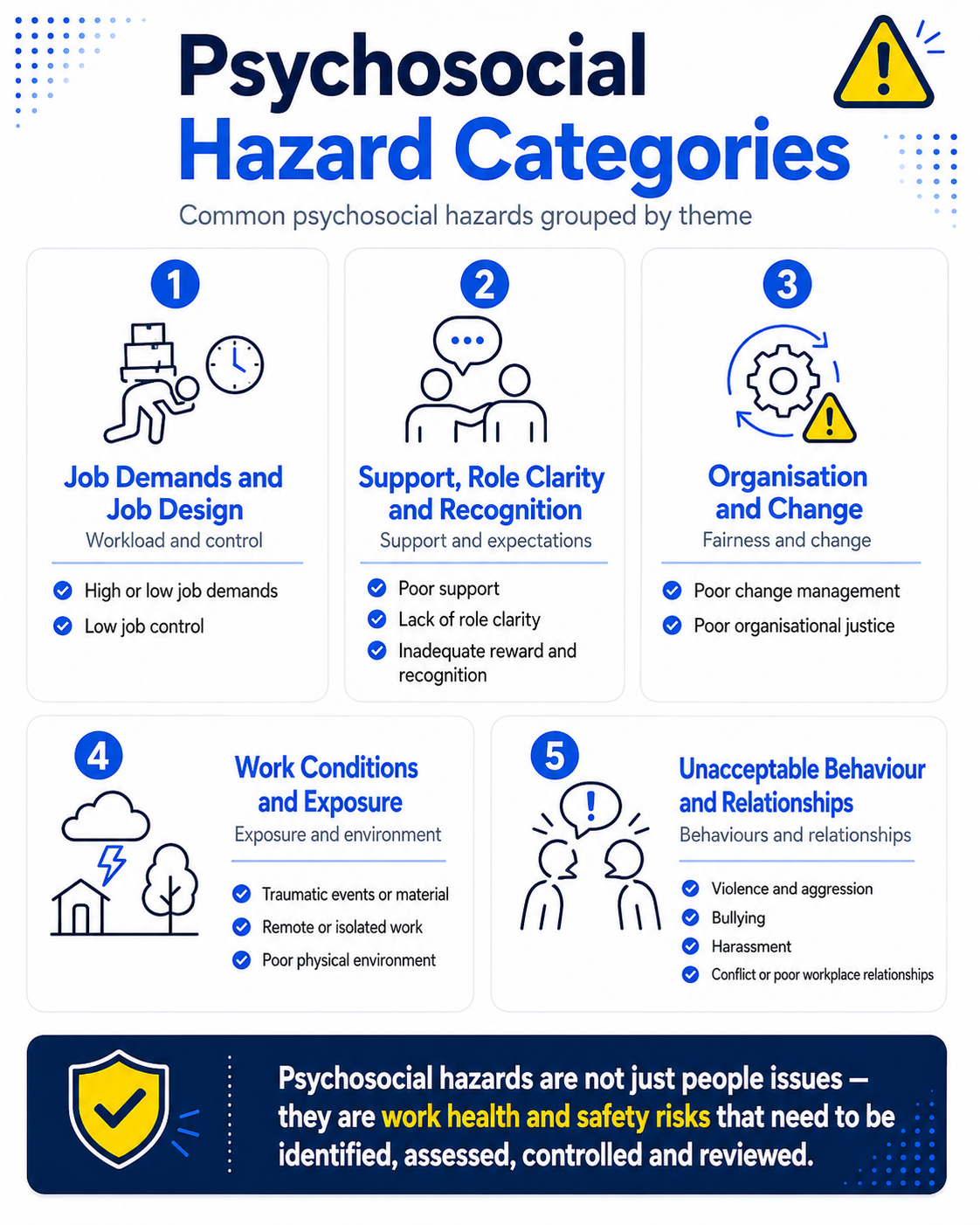
For trades, civil and construction businesses, the ones that get overlooked most are high job demands, violence and aggression from third parties, and remote or isolated work - not just the office-culture issues people tend to picture.
Your legal duty in Queensland
Under the Work Health and Safety Act 2011 (Qld), a PCBU has a primary duty to ensure, so far as is reasonably practicable, the health and safety of workers. Health includes psychological health - not just physical. That means you must manage psychosocial hazards the same way you manage any other WHS risk.
This is a positive duty. It is not enough to avoid doing the wrong thing; you must take active steps to eliminate psychosocial risks where reasonably practicable, and where you can’t eliminate them, minimise them so far as is reasonably practicable. The duty also extends to harm from third parties - clients, customers, patients or the public - not only from inside the business. WorkSafe Queensland provides Queensland-specific guidance and tools to support this.
The four steps you have to follow
Queensland expects psychosocial risk to be managed using the same four-step risk management process as any other hazard. It is ongoing, not a one-off exercise.
Identify the hazards. Look at how work is designed and done. Use what you already have — worker feedback, incident and complaint records, turnover, absenteeism, exit interviews - and talk to your workers.
Assess the risk. Consider how likely harm is, how serious it could be, who is exposed, and how hazards might combine. Psychosocial hazards rarely act alone, and the combination is often where the real risk sits.
Control the risk. Work down the hierarchy of control. Wherever reasonably practicable, eliminate the hazard by changing how the work is designed or organised - redesigning workloads, clarifying roles, fixing rostering. Administrative measures and support sit lower down, not first.
Review. Check that controls are working and review them after incidents, complaints, or changes to the work. This is a cycle, not a project with an end date.
What “reasonably practicable” means here
The standard is not perfection. So far as is reasonably practicable means weighing the likelihood and seriousness of the harm against what it would take to reduce it — the time, cost and effort involved. For psychosocial hazards, that usually means starting with how the work is designed and organised, because changing the source of the pressure is often cheaper and more effective than trying to manage its effects afterwards.
A small business is not expected to run the same program as a large corporate. It is expected to take genuine, proportionate steps for the hazards that are actually present, and to be able to show what those steps were. Proportionate and documented beats elaborate and theoretical every time.
Why documentation matters more than people think
A real risk here is doing some informal thinking about psychosocial issues and assuming that's enough. It often isn't. If a Workplace Health and Safety Queensland inspector visits - after a complaint, as part of a psychosocial campaign, or following an incident - they can require you to produce your psychosocial risk assessment. "We deal with it informally" is unlikely to satisfy them. And where a workplace has an elected health and safety representative, that HSR can also issue a Provisional Improvement Notice demanding a documented, consulted assessment. Either way, a written psychosocial risk register - hazards, risks, controls and review dates - is the evidence that you've met the duty.
A worked example: a small civil crew
Take a four-person civil crew doing roadside drainage work. Walk the hazards above and several are clearly live: high job demands during tight council deadlines, remote or isolated work when the crew splits across sites, and violence and aggression from frustrated motorists at traffic-control points.
The assessment flags the aggression risk as the most serious. Controls might include positioning traffic control to reduce direct confrontation, a clear procedure for disengaging and reporting abuse, regular check-ins for isolated workers, and more realistic scheduling to ease the deadline pressure. It is written into a one-page register with review dates. That is a proportionate, defensible response - not a corporate wellbeing program, but a real one that an inspector would recognise as meeting the duty.
Common mistakes Queensland businesses make
Treating it as an HR or wellbeing issue rather than a WHS duty with the same risk-management obligations as physical safety.
Doing nothing because nobody has complained - the duty is proactive, not reactive.
Ignoring third-party aggression (abusive customers, clients on site) when it’s a named hazard in the Code.
Running a single survey once and filing it - the duty is ongoing.
No documentation, so there’s nothing to show if asked.
Where to start
If you’ve done little so far, a sensible first pass looks like this:
Walk through the 14 hazards above against your own workplace and note which are realistically present.
Talk to your workers about what’s actually causing pressure or harm - consultation is required, and it’s also the best source of information.
Write it down in a simple psychosocial risk register: hazard, risk, controls, who’s responsible, review date.
Action the controls you can, starting with how the work is designed and organised.
Set a review date and treat it as a recurring obligation.
Sources and further reading
WorkSafe QLD – Managing the risk of psychosocial hazards at work Code of Practice 2022 — https://www.worksafe.qld.gov.au/laws-and-compliance/codes-of-practice/managing-the-risk-of-psychosocial-hazards-at-work-code-of-practice-2022
WorkSafe QLD – Mental health — https://www.worksafe.qld.gov.au/safety-and-prevention/mental-health
Work Health and Safety Act 2011 (Qld) — https://www.legislation.qld.gov.au/view/html/inforce/current/act-2011-018
WorkSafe QLD – Provisional improvement notices (PINs) — https://www.worksafe.qld.gov.au/safety-and-prevention/whs-consultation/provisional-improvement-notices-pins
WorkSafe QLD – Managing risks — https://www.worksafe.qld.gov.au/safety-and-prevention/creating-safe-work/managing-risks
Need help managing the risk of psychosocial hazards at you work place?
Squire Safety Consultants helps Queensland businesses with SWMS development, WHS documentation, safety management systems and practical workplace safety support - clear, compliant and usable documents that workers will actually follow.
If you would like help getting compliant with regards to Managing the risk of psychosocial hazards? reach out and lets get you there, Contact us.