
Injury management and return to work obligations for Queensland employers
Injury Management and Return to Work: What Queensland Employers Must Do
A worker gets hurt on site. Once the first aid is sorted and everyone has caught their breath, a second set of obligations kicks in, and this is where a lot of small businesses come unstuck. Injury management and return to work is not just paperwork for big companies. In Queensland, every employer carries real duties here, and getting them wrong can cost you money and a good worker.
This is a plain-English guide to what you actually have to do when a worker is injured, written for Queensland small and medium businesses in trades, civil and workshops. It is general information, not legal advice, so check the specifics of any claim with your insurer.
The duty every Queensland employer has
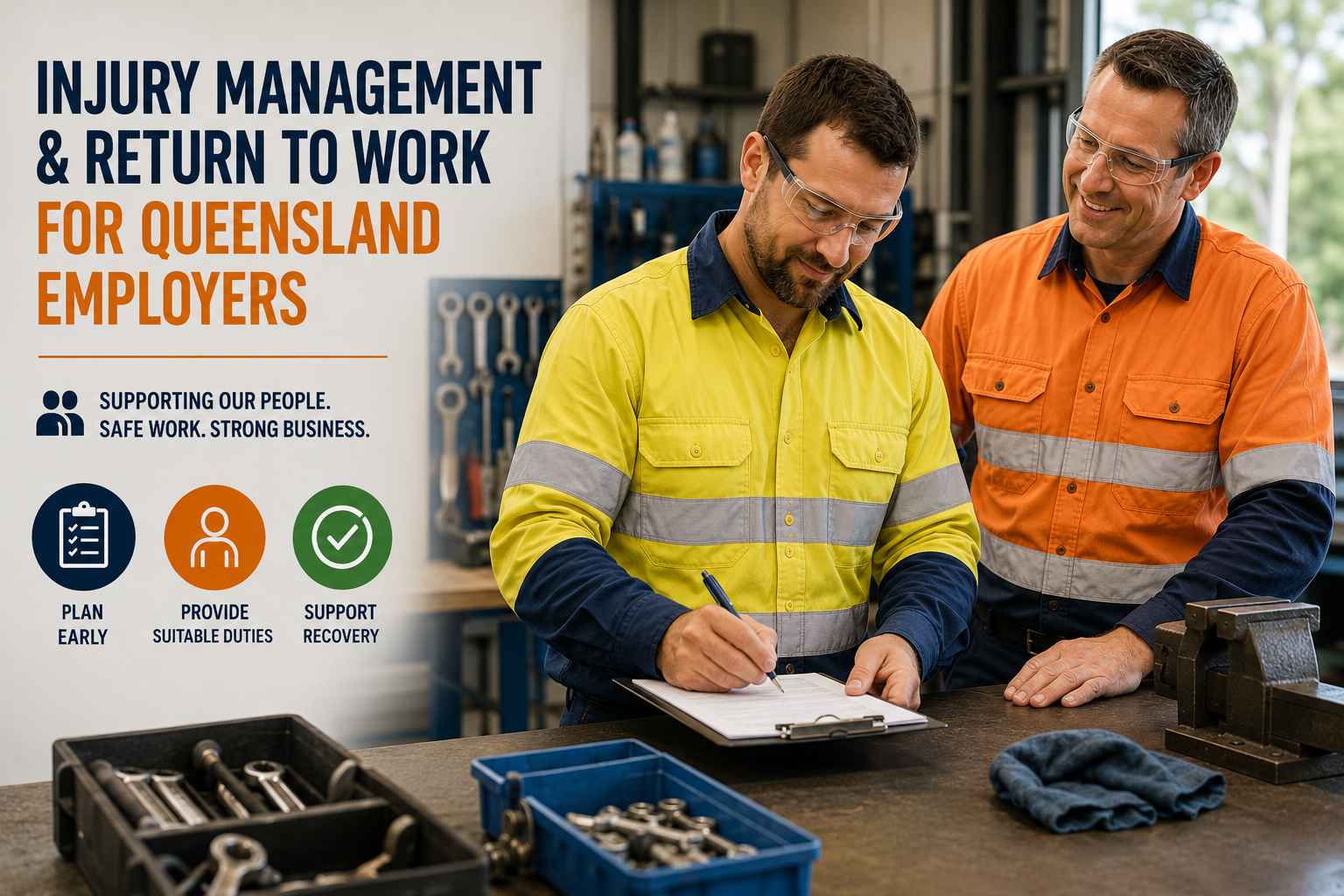
Offering workplace rehabilitation, which in practice means suitable duties, is an obligation for all Queensland employers. It does not matter how small you are. When a worker has a workers' compensation claim, the Workers' Compensation and Rehabilitation Act 2003 (Qld) says you must take all reasonable steps to assist or provide the worker with rehabilitation. That sits in section 228 of the Act, and the maximum penalty for breaching it is 500 penalty units.
Key point: Rehabilitation should start as soon as it is safe to do so after the injury. Early contact with your worker is one of the strongest things you can do for their recovery, and it is expected of you, not optional.
What to do when an injury happens
The first hours are about safety. After that, a clear sequence keeps you compliant and helps your worker recover.
1. Make the situation safe and provide first aid. Call 000 if it is an emergency.
2. Check whether the incident is also notifiable to Workplace Health and Safety Queensland. That WHS duty is separate from a workers' compensation claim.
3. Report the injury to your insurer within eight business days of becoming aware of it, using the approved employer report form. You must report an injury that may be compensable even if the worker does not lodge a claim and even if you dispute that it is work related.
4. Support your worker to see a doctor and get a Work Capacity Certificate, which sets out what they can and cannot do.
5. Start planning the return to work with your worker straight away. You can lodge a claim on their behalf if that helps.
Reporting is not the same as the worker making a claim, and the eight business day clock is on you. Failing to report within the timeframe without a reasonable excuse is an offence under the Act.
Suitable duties: the heart of return to work
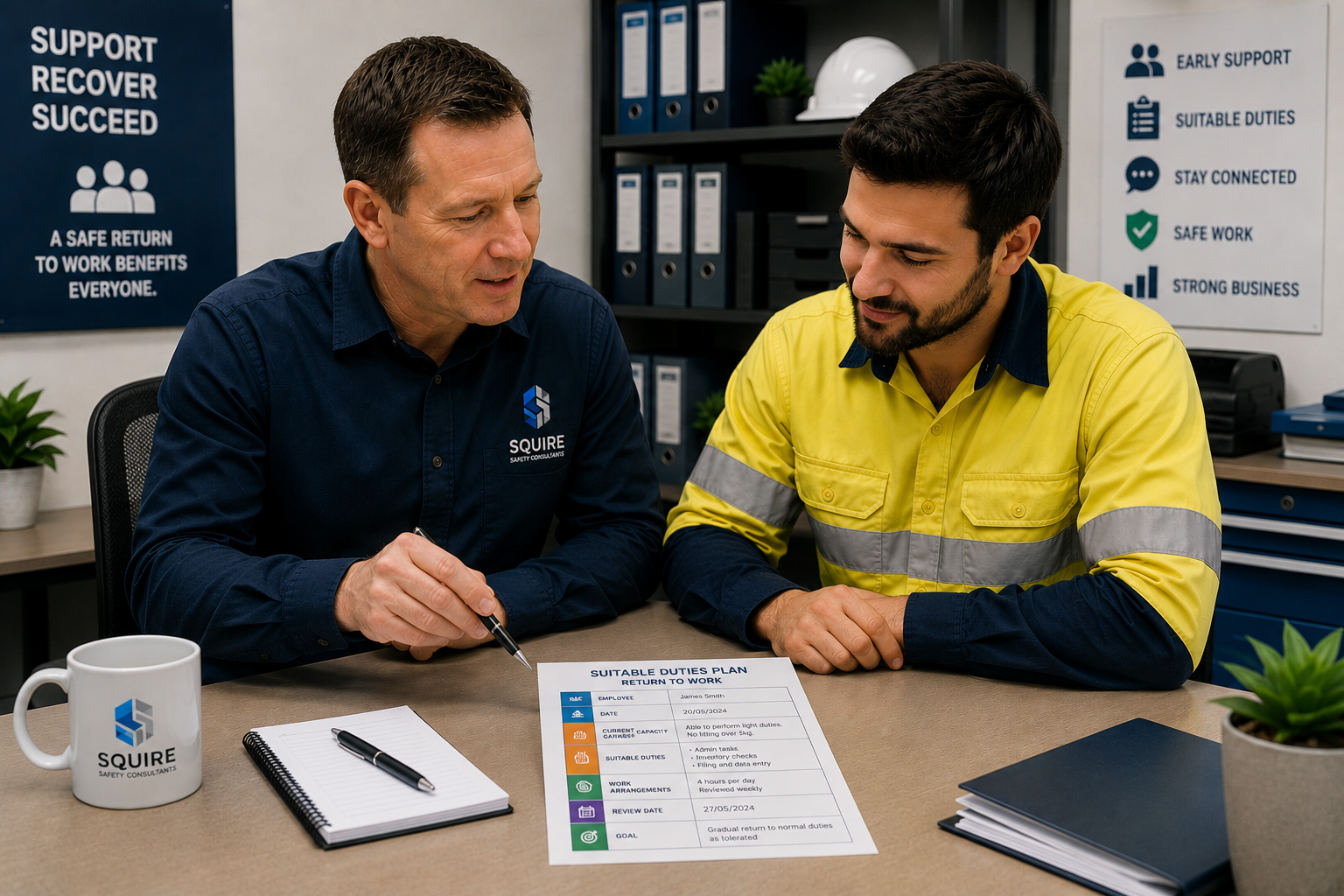
Suitable duties are real, productive tasks that fit within the worker's medical restrictions while they recover. They are not made-up busywork, and they are not whatever happens to be lying around. The duties have to match what the doctor has cleared the worker to do, and ideally help build their capacity back toward their normal role.
If you genuinely cannot provide suitable duties, you must give your insurer written notice setting out the reasons and supporting evidence. If your evidence is not sufficient, penalties may apply, so do not simply send a worker home and assume that is the end of it.
The My Recovery Plan (new from May 2026)
From 19 May 2026, WorkCover Queensland replaced the old Rehabilitation and Return to Work plan with the My Recovery Plan. Worker entitlements and the overall claims process have not changed. When a claim is accepted, WorkCover develops the My Recovery Plan within 10 business days, with input from the worker, you as the employer, and the treating providers, then shares it with everyone for feedback.
You do not fill the plan in yourself. WorkCover manages it and updates it as recovery, treatment or work capacity changes. Your job is to give honest input and to tell WorkCover when something at work changes that could affect recovery. Note that the My Recovery Plan is different from a suitable duties program, which is the document setting out the specific tasks your worker will do while they recover.
Do you need a Return to Work Coordinator?
This is where size finally matters. You must appoint a trained Rehabilitation and Return to Work Coordinator, and have written workplace rehabilitation policies and procedures, only if your Queensland wages for the preceding financial year were above a set threshold.
▪ Not in a high-risk industry: wages above 5,200 times QOTE, which is around 10.16 million dollars in the 2025-26 financial year.
▪ In a high-risk industry: wages above 2,600 times QOTE, which is around 5.08 million dollars in the 2025-26 financial year.
QOTE is Queensland Ordinary Time Earnings, set at 1,953.70 dollars per week for 2025-26 and indexed each 1 July, so these dollar figures move a little each year. The practical point for most small businesses is simple: you are almost certainly under the threshold, so a formally appointed coordinator is not mandatory for you. What does not change is the duty to support return to work. It is still smart to nominate one person, usually the owner or a supervisor, to own the process so injuries do not fall through the cracks. Where a coordinator is required, they must be based in Queensland, employed under a contract, and appropriately skilled, experienced or trained.
Protections you must respect
A few hard lines are worth knowing before you make any decision about an injured worker.
▪ You must not dismiss an injured worker within 12 months of the injury solely or mainly because they are not fit for their position. This is section 232B of the Act and carries a maximum penalty of 500 penalty units.
▪ Workers' compensation documents are to be used to support rehabilitation and return to work, not for disciplinary action or decisions about whether to keep someone on.
▪ You cannot offer a benefit, or threaten detriment, to influence a worker not to claim compensation.
Why this is worth doing well
Beyond staying on the right side of the law, good injury management keeps a skilled worker in your business rather than lost to a long absence, and a quick, safe return to work helps contain the cost of a claim, which feeds into your premium over time. Research consistently shows that staying connected to work, on the right duties, is good for a person's recovery. Done properly, this is one of the few areas where the compliant thing and the commercially smart thing are the same thing.
Frequently asked questions
Does a small business really have to offer suitable duties?
Yes. Offering workplace rehabilitation through suitable duties is an obligation for all Queensland employers when a worker has a claim, regardless of how small the business is.
How long do I have to report an injury?
Within eight business days of becoming aware of it. You report it even if the worker does not make a claim and even if you do not agree it is work related.
Do I need a Return to Work Coordinator?
Only if your Queensland wages exceed the threshold (5,200 times QOTE, or 2,600 times QOTE in a high-risk industry). Most small businesses fall under this and do not need a formally appointed coordinator, but still must support return to work.
Can I let an injured worker go?
Not within 12 months of the injury if the reason is solely or mainly that they are unfit for the position because of the injury. Doing so can attract penalties and reinstatement orders.
If you would rather have a simple, compliant injury management and return to work process ready before you ever need it, that is exactly what we set up for Queensland small businesses: clear steps, suitable duties templates, and someone to call when a claim lands. Get in touch with Squire Safety Consultants for a straightforward review of where you stand.
A note for businesses operating interstate: workers' compensation is run state by state. The principles here, early intervention, suitable duties and not penalising an injured worker, carry across, but the scheme, the forms and the coordinator rules differ in each state, so do not assume the Queensland detail applies elsewhere.