
Safe Operating Procedure: What It Is and Why It Matters
What Is a Safe Operating Procedure and When Do You Need One?
Introduction
A safe operating procedure, often shortened to SOP, is one of the simplest ways to make sure a task is done safely, consistently and correctly.
If a task involves machinery, equipment, hazardous substances, manual handling, cleaning, maintenance or any activity where things can go wrong, an SOP helps workers understand the right steps to follow before they start.
In this article, I’ll explain what a safe operating procedure is, what an SOP should include, how it relates to WHS legislation, and how it differs from a SWMS or JSA.
What Is a Safe Operating Procedure?
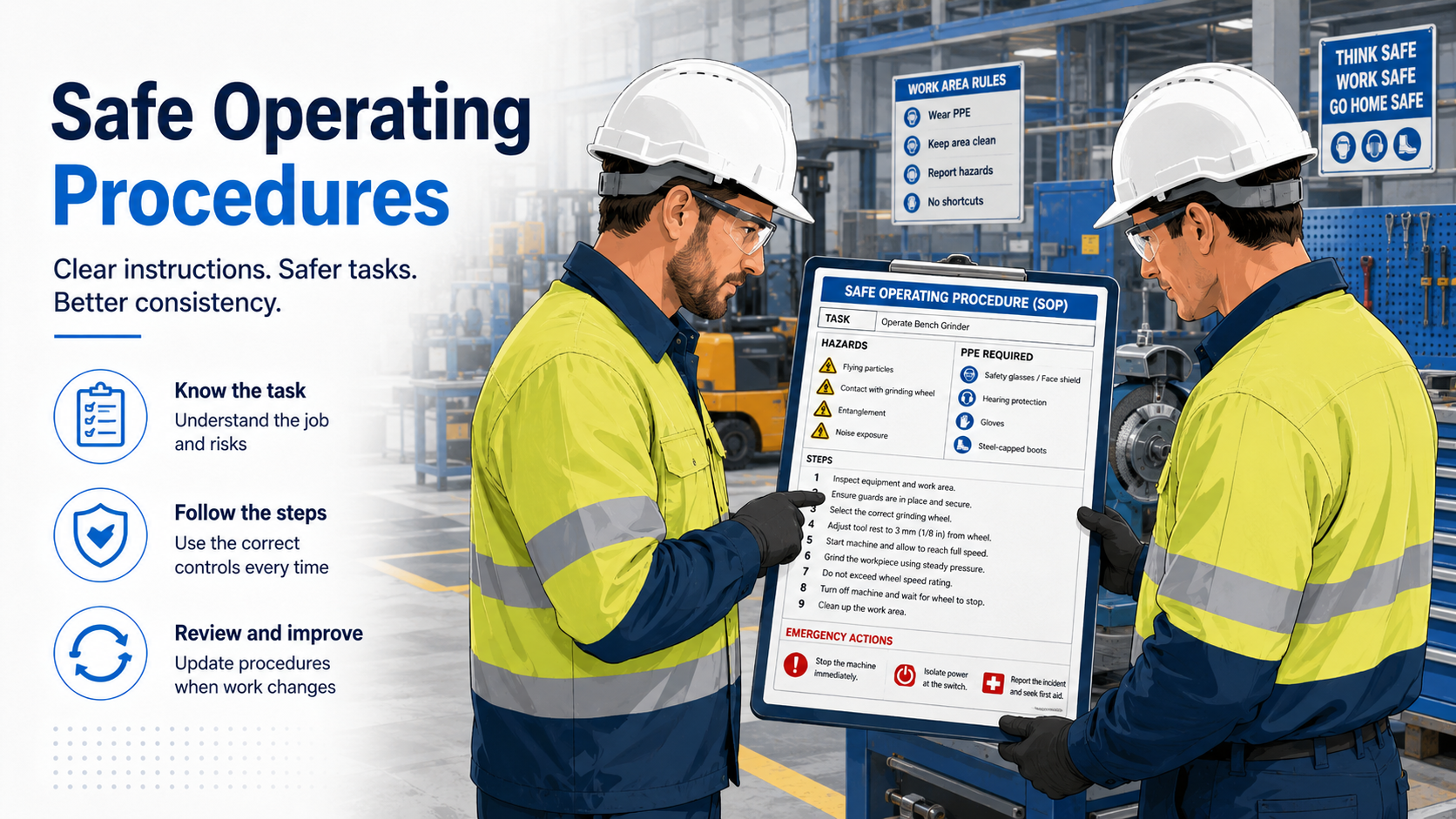
A safe operating procedure is a written instruction that explains how to complete a task safely and consistently.
It usually covers:
What the task involves
The hazards linked to the task
The controls that must be followed
Required PPE
Pre-start checks
Step-by-step instructions
Emergency or shutdown steps
Cleaning, maintenance or reporting requirements
In my experience, the best SOPs are not long, complicated documents. They are practical instructions workers can actually use.
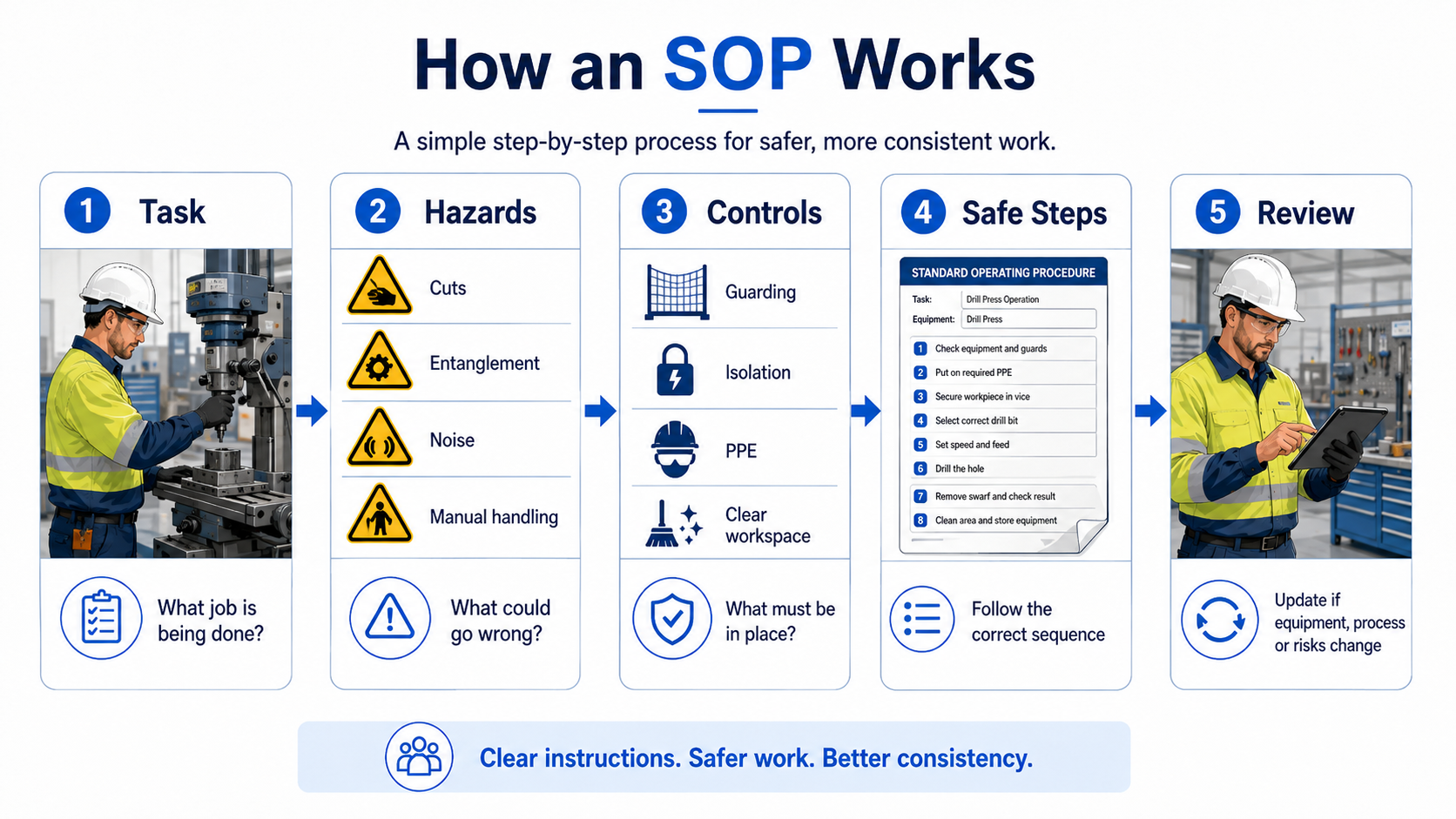
A good SOP should make it clear:
What needs to be done.
Who is allowed to do it.
What hazards are involved.
What controls must be in place.
What to do if something goes wrong.
What Does SOP Stand For?
SOP stands for Safe Operating Procedure or Standard Operating Procedure, depending on the workplace.
In safety management, the term is often used to describe a documented safe way to complete a task.
Some businesses also use the term Safe Work Procedure, or SWP. The wording may differ, but the purpose is usually the same: to give workers clear instructions for carrying out a task safely.
Is a Safe Operating Procedure Required by Law?
In most cases, WHS legislation may not specifically say, “you must have an SOP for every task.” However, SOPs are strongly linked to legal duties around safe systems of work, risk control, information, training, instruction and supervision.
Under the model WHS Act, a PCBU must ensure, so far as is reasonably practicable, the health and safety of workers and other persons. This includes providing and maintaining safe systems of work, safe plant and structures, safe use and handling of plant, structures and substances, and the information, training, instruction or supervision needed to protect people from risks.
The model WHS Regulations also require information, training and instruction provided to workers to be suitable and adequate, considering the nature of the work, the risks associated with the work, and the control measures implemented.
So, while an SOP may not always be named directly in the legislation, it is often a very practical way to show how your business provides safe work instructions and manages known risks.
It is also important to remember that model WHS laws only have legal effect when implemented in each state or territory, and local variations can apply. Safe Work Australia notes that the Commonwealth, states and territories regulate and enforce WHS laws in their own jurisdictions.
Why Safe Operating Procedures Matter
A safe operating procedure helps turn safety requirements into clear action.
Without an SOP, workers may rely on memory, shortcuts, informal training or “the way we’ve always done it”. That can create problems, especially when:
New workers are learning the task
Equipment has specific safety requirements
A task is done infrequently
Multiple people perform the task differently
The task involves machinery, chemicals, vehicles or stored energy
There has been an incident, near miss or recurring issue
An SOP helps create consistency. It gives workers and supervisors a shared reference point for how the job should be done.
What Should Be Included in a Safe Operating Procedure?
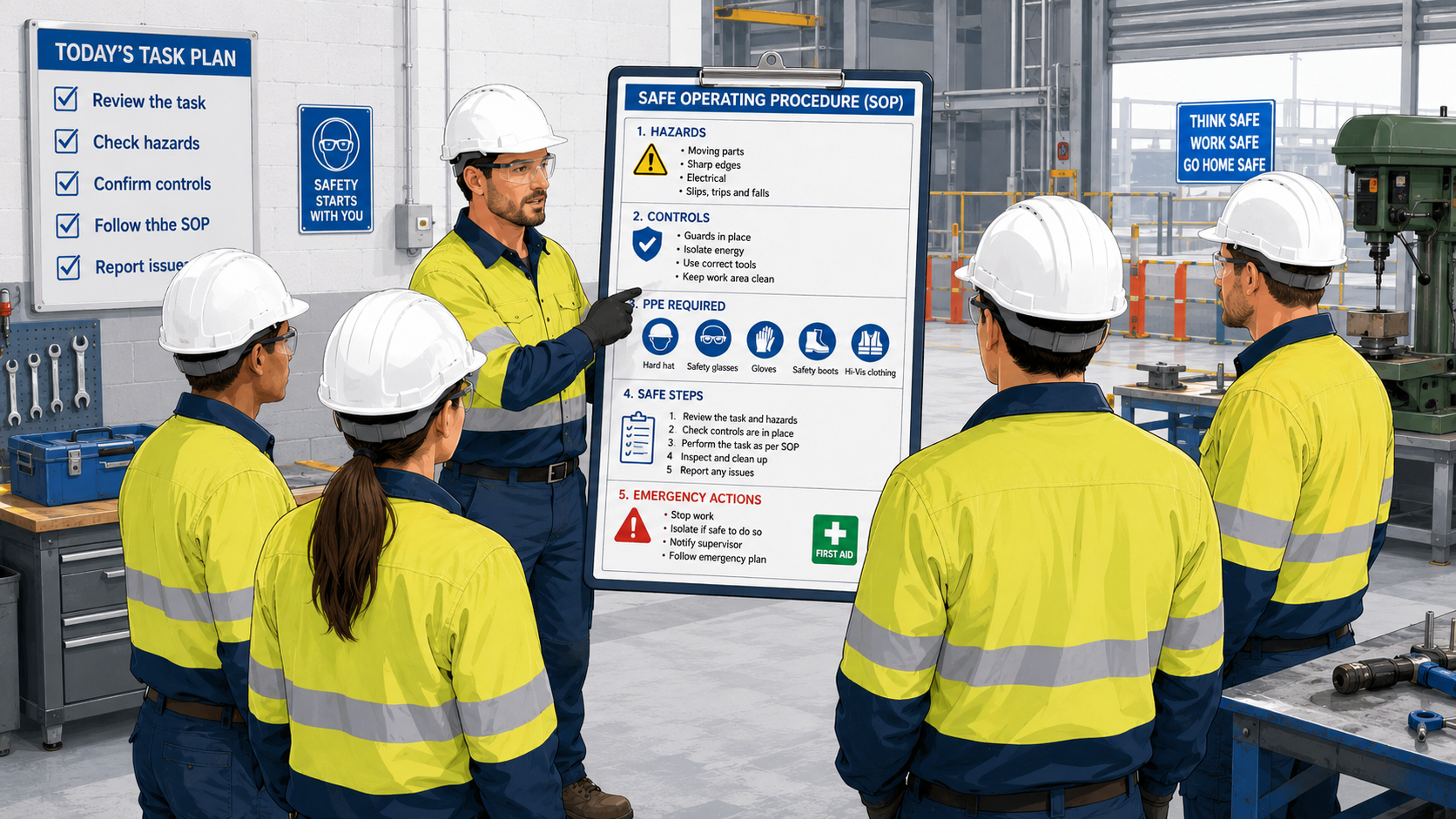
A safe operating procedure should be clear enough that a competent worker can follow it without guessing.
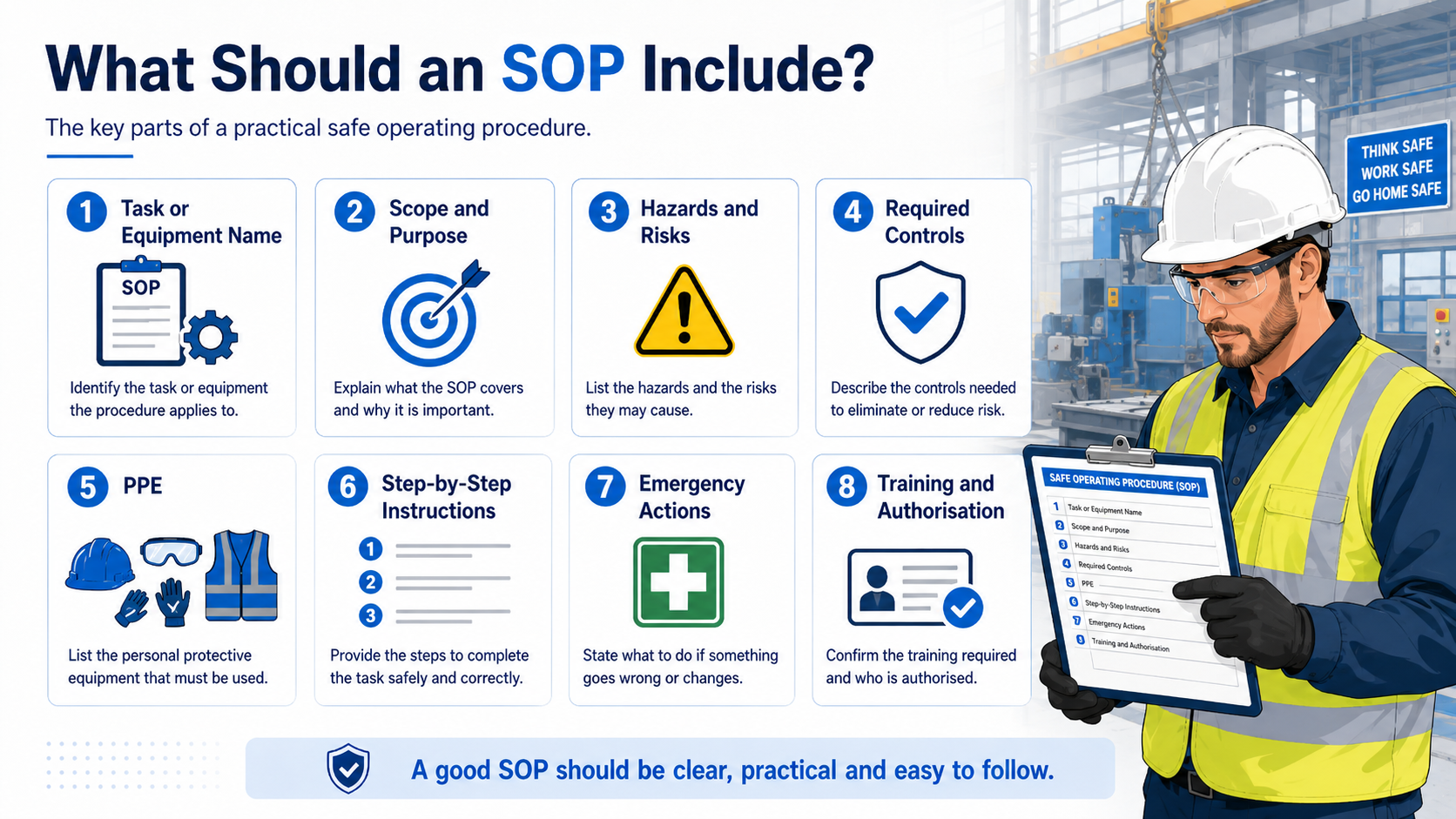
A practical SOP will usually include the following sections.
1. Task or equipment name
Start with a clear title.
For example:
Operating a bench grinder
Using a forklift to unload pallets
Cleaning a chemical storage area
Changing blades on a saw
Using a pressure washer
Avoid vague titles such as “workshop task” or “machine use”. The title should tell the worker exactly what the SOP applies to.
2. Scope and purpose
Explain what the SOP covers and when it should be used.
For example:
“This SOP applies to trained workers using the pedestal drill in the fabrication workshop.”
This helps prevent the document being used for the wrong equipment, task or environment.
3. Hazards and risks
List the real hazards linked to the task.
Examples may include:
Entanglement
Crushing
Cutting or laceration
Noise exposure
Flying particles
Manual handling strain
Chemical exposure
Electrical hazards
Hot surfaces
Stored energy
The Safe Work Australia plant Code of Practice notes that plant includes machinery, equipment, appliances, implements and tools, and that plant is a major cause of work-related death and injury in Australian workplaces.
4. Required controls
This is one of the most important parts of the SOP.
Controls may include:
Machine guarding
Isolation or lockout requirements
Exclusion zones
Ventilation
Two-person lifts
Competency requirements
Signage
Maintenance checks
PPE
Emergency stop procedures
The WHS Regulations require duty holders to work through the hierarchy of control measures when managing risks, and the model Regulations set out requirements for elimination, minimisation, administrative controls and PPE where risks remain.
5. Required PPE
List the specific PPE required for the task.
For example:
Safety glasses
Face shield
Hearing protection
Gloves
Respiratory protection
Steel-capped boots
High-visibility clothing
Avoid writing “wear appropriate PPE” unless you clearly define what “appropriate” means.
6. Step-by-step safe operating instructions
This should be the main part of the SOP.
Break the task into logical steps, such as:
Complete pre-start checks.
Inspect guards and safety devices.
Confirm the work area is clear.
Set up the equipment correctly.
Operate the equipment using the approved method.
Shut down safely.
Clean the area.
Report faults or defects.
The steps should be short, direct and written in plain English.
7. Emergency instructions
Include what workers should do if something goes wrong.
This may include:
How to shut down the equipment
Where the emergency stop is located
Who to notify
First aid requirements
Spill response steps
Evacuation or isolation requirements
8. Training and authorisation
An SOP should identify who is allowed to perform the task.
For higher-risk equipment or tasks, workers may need:
Formal training
Verification of competency
Licences or tickets
Site induction
Supervisor approval
Refresher training
Safe Work Australia guidance states that workers must be given relevant health and safety information about their jobs and workplace, including potential risks, how to work safely, policies and procedures, how to raise WHS issues, and emergency arrangements.
Safe Operating Procedure Example
Here is a simplified example of what an SOP might include.
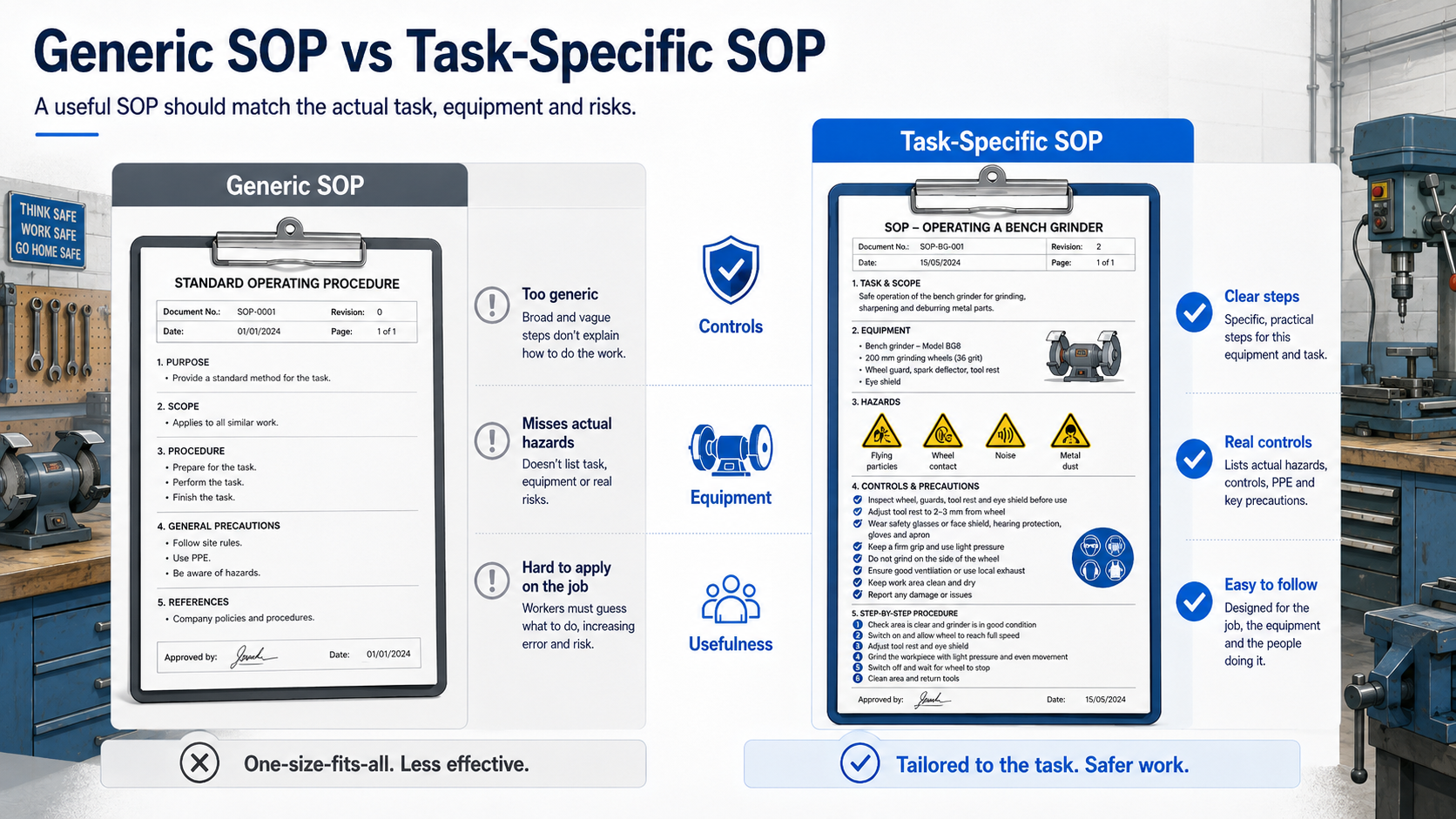
SOP: Operating a Bench Grinder
Hazards:
Flying particles
Wheel failure
Entanglement
Noise
Contact with rotating wheel
Controls:
Inspect wheel and guards before use
Ensure tool rest is correctly adjusted
Wear safety glasses and face shield
Do not wear loose clothing or jewellery
Keep hands clear of grinding wheel
Do not use damaged wheels
Allow wheel to reach full speed before grinding
Safe steps:
Inspect the grinder, guard, wheel and tool rest.
Confirm the emergency stop is working and accessible.
Put on required PPE.
Stand to the side when starting the grinder.
Apply material gently to the wheel.
Do not force the workpiece.
Switch off the grinder after use.
Wait for the wheel to stop before leaving.
Report any damage, vibration or unusual noise.
This type of SOP is practical because it gives workers clear instructions, not just general safety reminders.
If you need a SOP that is ready to download and use check out our SOP Templates Here
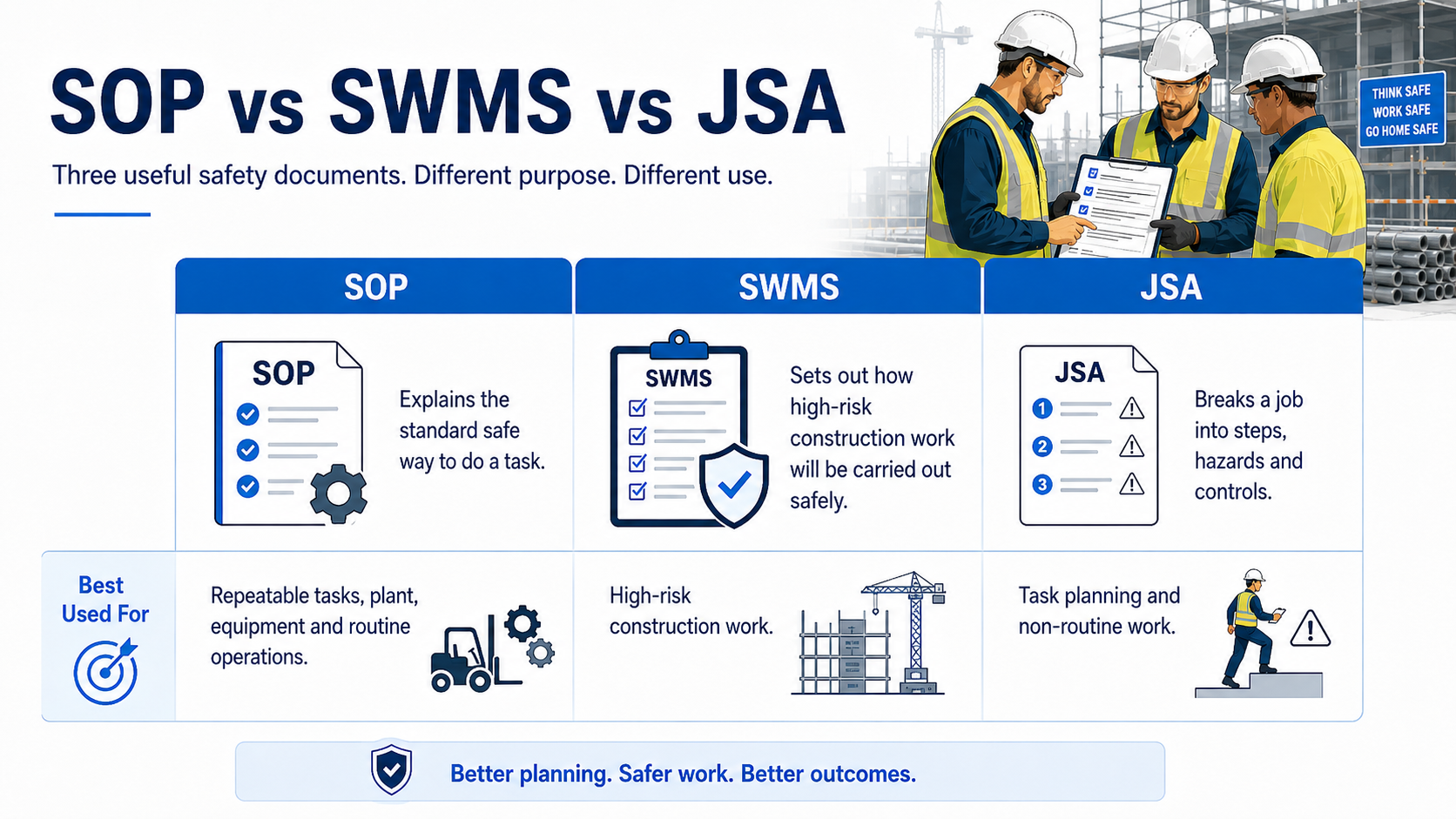
SOP vs SWMS vs JSA: What Is the Difference?
A common question is whether an SOP is the same as a SWMS or JSA.
They are related, but they are not the same.
Document Main Purpose Common Use
SOP Explains the standard safe way to complete a task Repeated tasks, plant, equipment and routine operations
SWMS Sets out how high-risk construction work will be carried out safely Required for high-risk construction work
JSA Breaks a job into steps, hazards and controls Task planning, non-routine work and risk assessment
A safe operating procedure is usually best for repeatable tasks.
A SWMS is specifically connected to high-risk construction work. The model plant Code of Practice references WHS Regulation 299, which requires a SWMS for high-risk construction work.
A JSA is useful when a job needs to be assessed step by step, especially if the work is unusual, changing or not already covered by an SOP.
In many workplaces, these documents work together. For example, a business may have an SOP for operating an excavator, a JSA for a specific unusual task, and a SWMS if the work involves high-risk construction work.
When Should You Create a Safe Operating Procedure?
I recommend creating an SOP when a task is repeated, has known risks, or needs to be performed consistently.
Common examples include:
Operating machinery
Using power tools
Forklift or mobile plant operation
Handling hazardous chemicals
Cleaning plant or equipment
Lockout and isolation
Manual handling tasks
Working with heat, pressure or stored energy
Loading and unloading
Maintenance activities
Using workshop equipment
You should also consider creating or reviewing an SOP after:
An incident or near miss
A change in equipment
A change in work process
A new chemical or substance is introduced
A worker raises a safety concern
A risk assessment identifies unclear controls
A supervisor observes inconsistent work practices
The Safe Work Australia plant Code of Practice says safety information may be supported with safe work procedures covering items such as guarding, immobilisation, safe access and operation, authorised use, inspections, shutdown, cleaning, maintenance, traffic rules, malfunctions, emergency procedures and PPE.
Common SOP Mistakes I See
A safe operating procedure can lose value quickly if it is written poorly or not used properly.
Common mistakes include:
Copying a generic SOP without checking the actual task
Making the SOP too long for workers to use
Using technical language workers do not understand
Listing hazards without clear controls
Relying too heavily on PPE
Not consulting workers who perform the task
Not updating the SOP after changes
Keeping the SOP in a folder instead of using it during training
Assuming a signed SOP means the worker is competent
The biggest issue is usually practicality. If the SOP does not match how the task is actually done, workers will ignore it or create their own informal method.
If you need assistance with SOP writting or would like our team to create them for you reach and lets scope what you need - Contact Us
How to Write a Useful SOP
A good SOP should be written with the people doing the work, not just for the paperwork file.
Here is a simple process:
Watch the task being performed
Do not write the SOP from memory. Look at the actual work area, tools, equipment and hazards.Consult the workers
Ask the people doing the task what can go wrong, what controls work, and where the current process is unclear.Check manuals and safety data
Use manufacturer instructions, safety data sheets, codes of practice and risk assessments where relevant.Identify hazards and controls
Apply the hierarchy of control. Do not jump straight to PPE.Write the steps in plain English
Keep each step short and specific.Test the SOP
Ask a competent worker or supervisor to review whether it reflects the real task.Train workers in the SOP
A document by itself is not enough. Workers need instruction, demonstration and supervision where required.Review it regularly
Update the SOP when equipment, substances, controls, site conditions or work methods change.
How Often Should SOPs Be Reviewed?
There is no single review period that suits every business.
As a general rule, SOPs should be reviewed:
At planned intervals
When equipment changes
When the work process changes
After an incident or near miss
When a new hazard is identified
When workers report that the procedure is unclear
When legislation, codes or manufacturer instructions change
For higher-risk tasks, I recommend reviewing SOPs more often and keeping a clear record of the review date, reviewer and any changes made.
Final Thoughts: An SOP Should Make Safe Work Easier
A safe operating procedure is not just a document for compliance. It is a practical tool that helps workers complete tasks safely, consistently and with fewer assumptions.
A good SOP explains the task, the hazards, the required controls, the safe steps and what to do if something goes wrong. It should be simple enough to use, detailed enough to be useful, and reviewed when work changes.
Squire Safety Consultants can help businesses develop safe operating procedures, SWMS documents, WHS management systems, risk assessments and practical safety documentation that is clear, compliant and usable on site. - View our Services Here
If you're interested in learning more or working together, feel free to get in touch - Contact Us