
What Is a Safe Work Method Statement? SWMS Explained
What Is a Safe Work Method Statement and When Do You Need One?
Introduction
If you work in construction, trades, maintenance, civil works or any high-risk work environment, you have probably heard someone ask, “What is a SWMS?” or “When is a SWMS required?”
A Safe Work Method Statement, commonly called a SWMS, is one of the most important safety documents used in Australian construction and high-risk work. It helps workers understand the hazards involved in a task, what can go wrong, and what controls must be followed to carry out the work safely.
In this article, I’ll explain what a safe work method statement is, what SWMS stands for, what the purpose of a SWMS is, when you need one, and how it differs from a JSA.
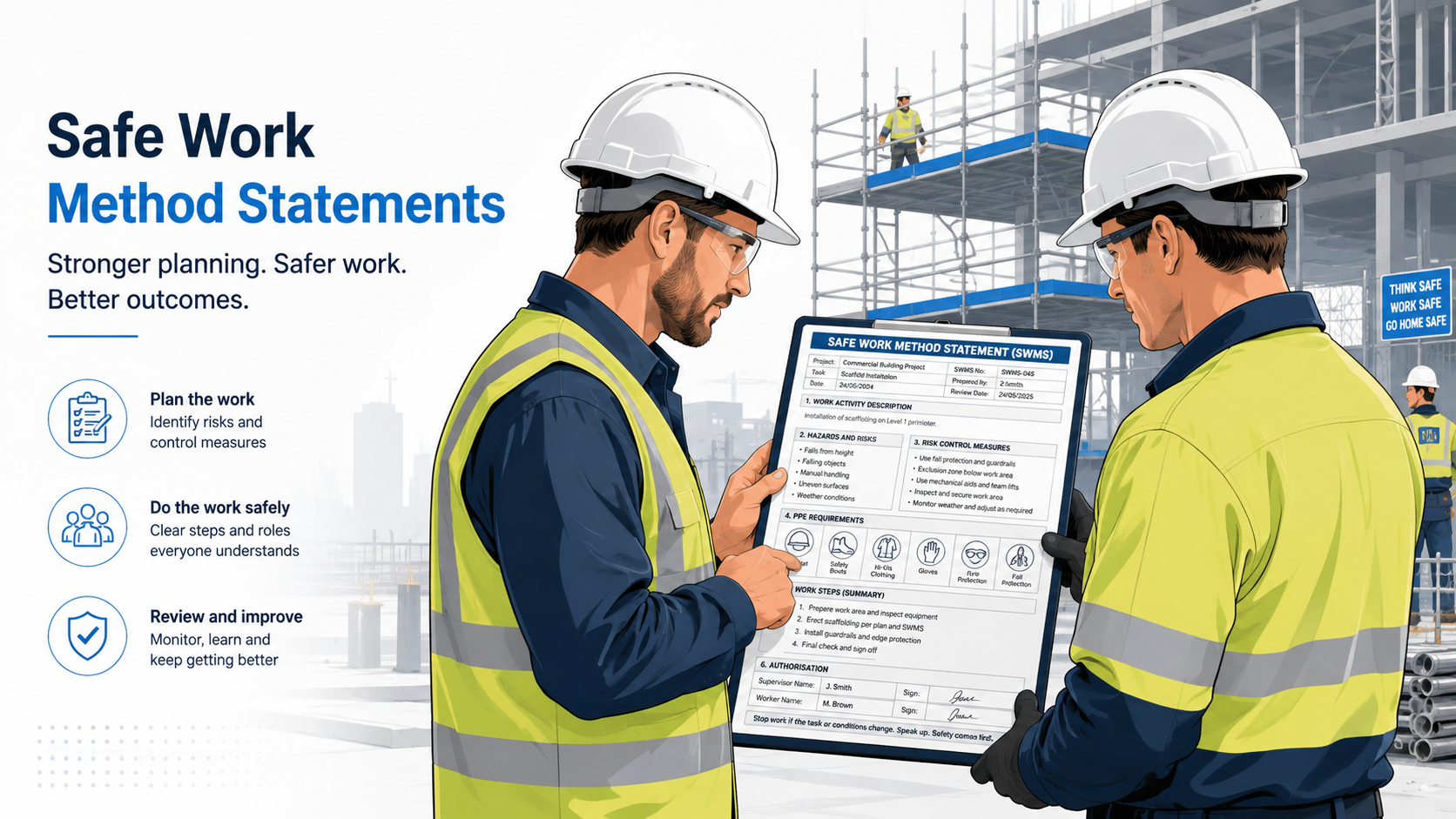
What Does SWMS Stand For?
SWMS stands for Safe Work Method Statement.
In simple terms, a SWMS is a written safety document that sets out:
• The high-risk construction work being carried out
• The hazards and risks linked to that work
• The control measures that will be used
• How those controls will be implemented, monitored and reviewed
So, when people ask “what does SWMS mean?”, the practical answer is this:
A SWMS explains how high-risk work will be done safely before the work starts.
What Is a Safe Work Method Statement?
A Safe Work Method Statement is a site-specific document used to plan and communicate how high-risk construction work will be completed safely.
It is not meant to be a long, complicated document that nobody reads. In my experience, the best SWMS documents are clear, practical and easy for workers to understand.
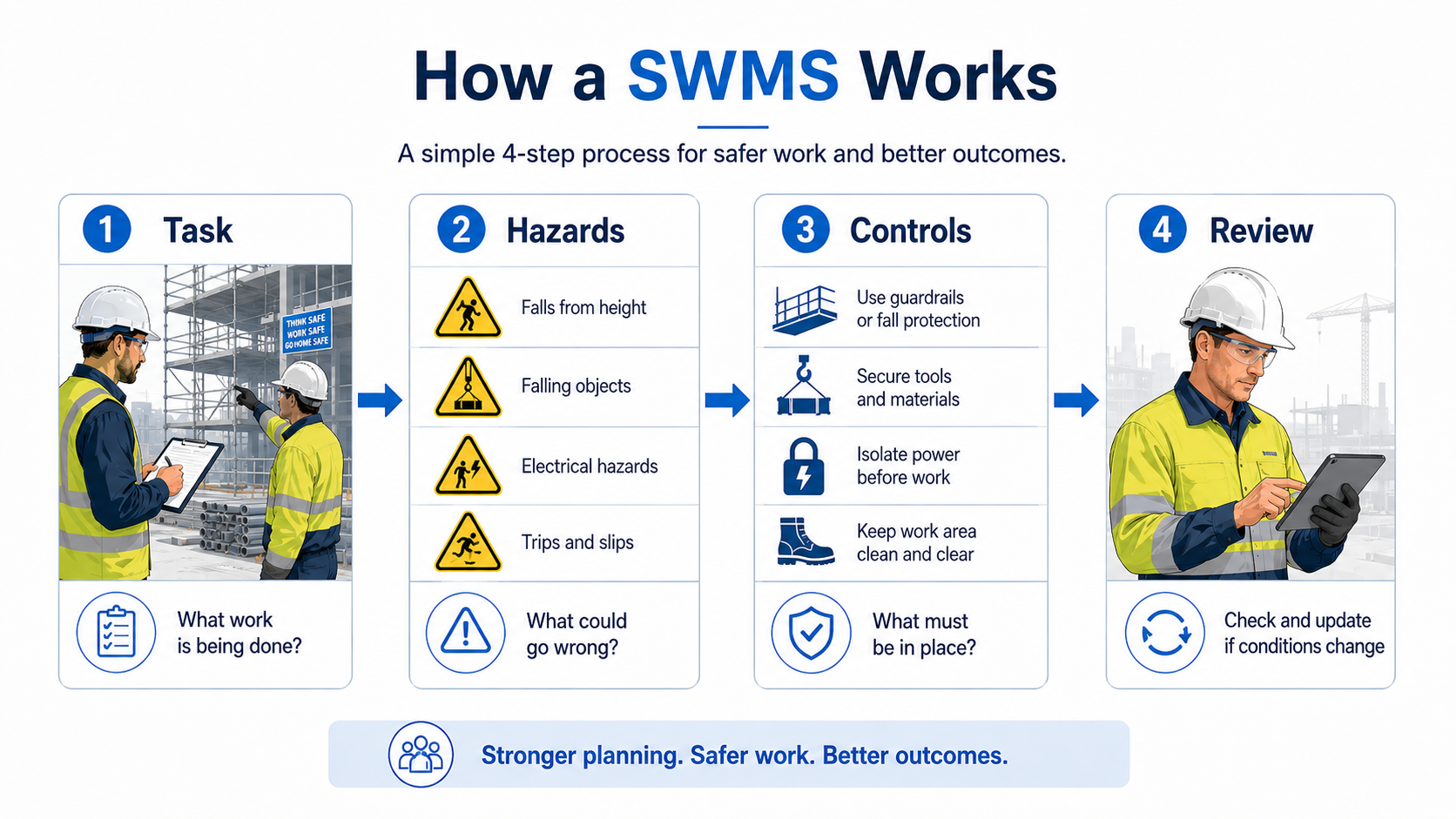
A good SWMS should answer four key questions:
What high-risk work is being performed?
What hazards and risks are involved?
What controls are required?
How will those controls be checked and maintained?
What Is the Purpose of a SWMS?
The purpose of a SWMS is not just to satisfy paperwork requirements. A SWMS should help workers and supervisors make better safety decisions before and during high-risk work.
A SWMS helps by:
Identifying high-risk construction work before it starts
Making hazards and risks clear to workers
Setting out the controls that must be followed
Giving supervisors a way to monitor work
Helping ensure everyone understands the safe method of work
Providing evidence that risks have been considered and controlled
A SWMS should also be used as part of toolbox talks, pre-start meetings and site inductions. If it sits in a folder and no one uses it, it is not doing its job.
What Is a SWMS Document?
A SWMS document is the written record of how a high-risk activity will be managed safely.
A typical SWMS document will include:
Business or PCBU details
Principal contractor details, where relevant
Work activity description
Site or workplace location
High-risk construction work category
Hazards and risks
Control measures
Responsibilities
Monitoring and review process
Worker consultation or sign-on section
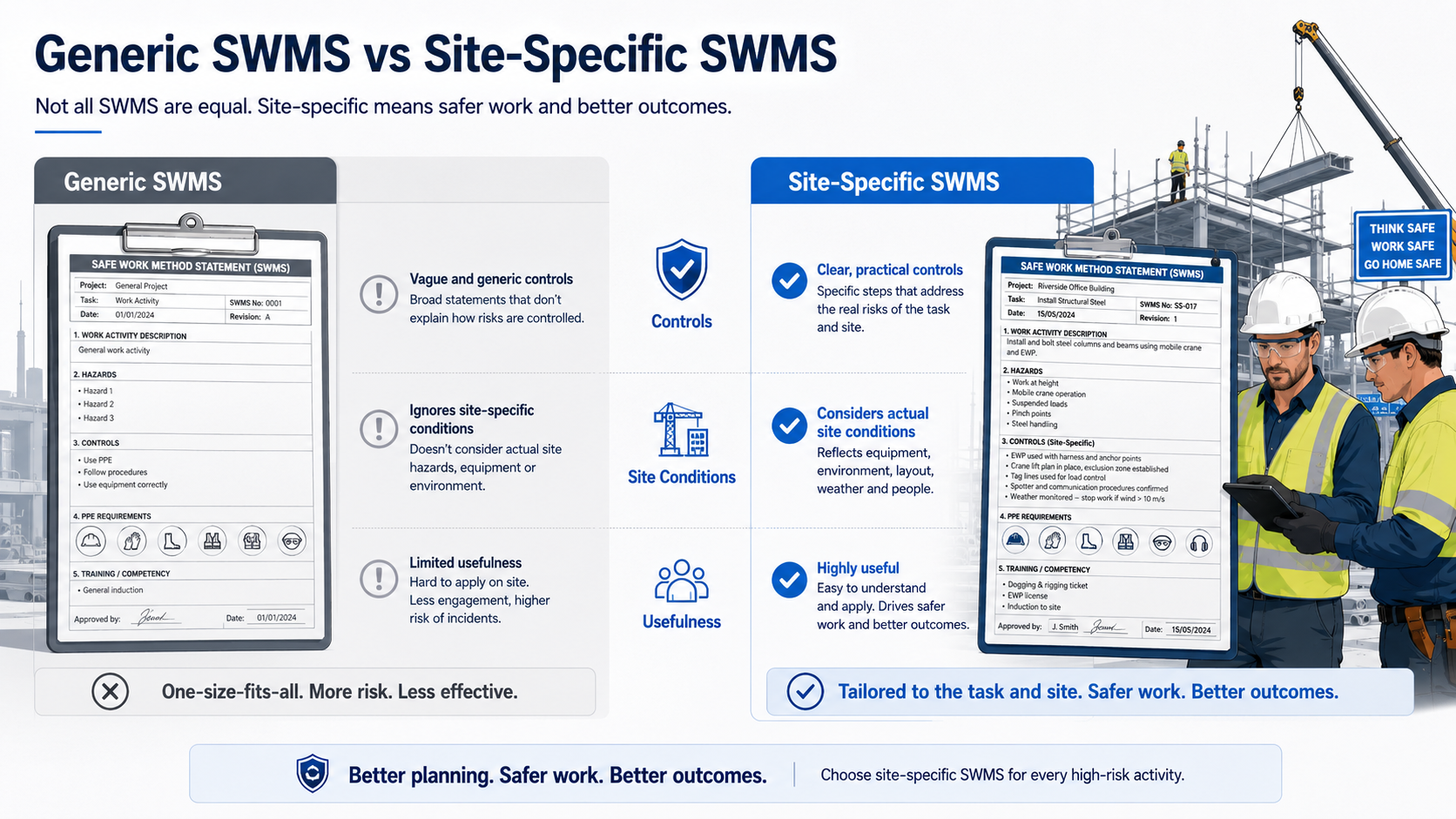
That last point is important. A generic SWMS template can be a useful starting point, but it should not be treated as a finished document unless it reflects the actual work, site conditions and people involved.
Squire Safety Consultants has a large range of Pre-filled SWMS templates available, these are a fantastic starting point for when you need a SWMS in place fast, just download, edit, review and go! check out the full library available here.
What Is SWMS in Construction?
In construction, a SWMS is specifically required for high-risk construction work.
Common construction tasks that may require a SWMS include:
• Roofing work
• Excavation and trenching
• Working near live services
• Crane lifts and mobile plant operations
• Demolition work
• Structural alterations
• Work near roads or traffic corridors
• Work in confined spaces
• Work involving asbestos-containing materials
A SWMS is especially useful on construction sites because there are often multiple trades, changing site conditions and overlapping activities. A task that looks straightforward in isolation can become much riskier when other contractors, plant, deliveries, weather or public access are involved.
When Is a SWMS Required?
A SWMS is required before high-risk construction work starts.
In practical terms, you should check whether a SWMS is required when the work involves:
• Heights
• Excavations
• Mobile plant
• Electrical services
• Confined spaces
• Structural demolition or alteration
• Asbestos
• Traffic or public interface
• Water or drowning risks
• Artificial temperature extremes
For other construction activities, a SWMS may not be legally required, but the business still needs to manage health and safety risks so far as is reasonably practicable.
My recommendation is simple: if the task is high-risk, unfamiliar, complex or being performed in a changing environment, pause and check whether a SWMS is required before starting.
If you require assistance with working out if a task fall under the High Risk Construction Work classification or need assistance with writing SWMS contact our team - Work with Us
What Should Be Included in a SWMS?
A SWMS should be practical enough that a supervisor or worker can use it on site.
At a minimum, it should clearly identify:
The work activity
Describe the task in plain English. For example:
“Install roof sheeting on a single-storey commercial building using scaffold access and mobile crane lifting.”
The high-risk construction work category
Identify which high-risk category applies, such as working at heights, powered mobile plant, structural alteration or work near energised services.
The hazards and risks
List what could actually harm someone. Avoid vague wording such as “general site hazards” unless you explain what that means.
Examples include:
• Fall from height
• Contact with overhead powerlines
• Mobile plant striking workers
• Trench collapse
• Falling objects
• Exposure to asbestos fibres
The control measures
This is where many SWMS documents become too weak. Controls need to be specific.
Instead of writing:
“Use appropriate PPE.”
Write:
“Workers must wear hard hats, safety glasses, gloves, steel-capped boots and high-visibility clothing while inside the work zone.”
How controls will be monitored and reviewed
A SWMS should explain how the business will check that controls are actually being followed. This may include supervisor inspections, toolbox talks, pre-start checks or task observations.
What Is the Difference Between a JSA and a SWMS?
A common question is: what is the difference between a JSA and a SWMS?
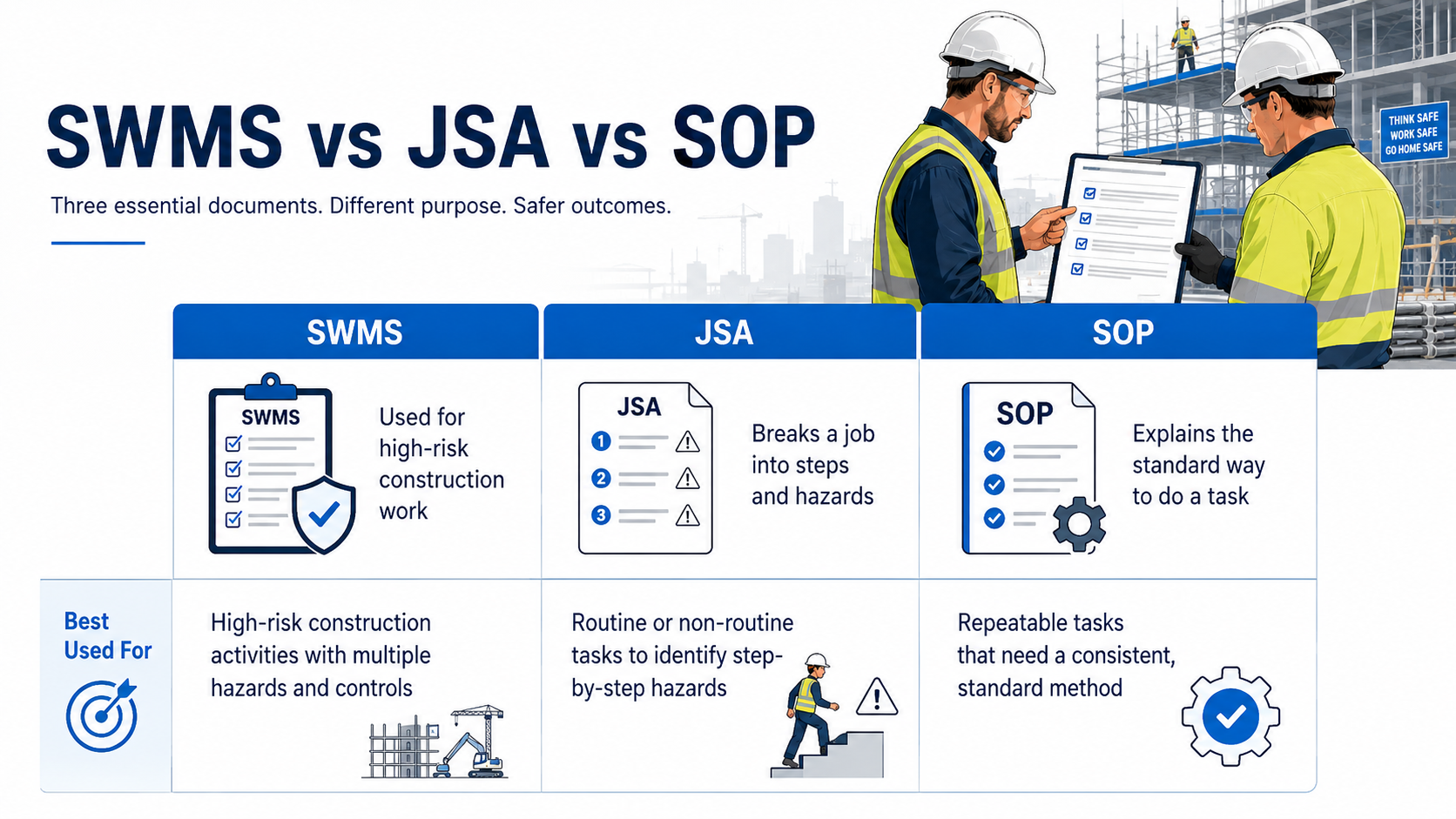
A JSA, or Job Safety Analysis, is generally used to break down a task into steps, identify hazards and apply controls. A SWMS is specifically required for high-risk construction work and must address the required SWMS content under WHS requirements.
In simple terms:
Document Main Purpose Common Use
SWMS Manages high-risk construction work Required for high-risk construction activities
JSA Breaks a job into steps and identifies hazards Useful for task planning and general risk management
SOP Explains a standard operating process Common for repeated tasks or equipment use
What Is JSA and SWMS Used For?
A JSA and SWMS can both support safer work, but they are not always interchangeable.
A JSA is useful when you want to step through a task in detail. A SWMS is required when the task involves high-risk construction work.
For example:
• A JSA may be used for changing a tyre on a light vehicle in a workshop.
• A SWMS may be required for excavation work near underground electrical services.
• A JSA may support the planning process, but the SWMS must still meet the legal requirements for high-risk construction work.
In many businesses, both documents are used together. The key is knowing which document is required and making sure it is specific to the work being performed.
Common SWMS Mistakes I See
A SWMS can quickly become a box-ticking exercise if it is not prepared properly.
The most common mistakes include:
• Using a generic SWMS without reviewing site conditions
• Listing hazards but not giving clear controls
• Writing controls that are too vague
• Making the SWMS too long for workers to use
• Failing to consult workers before the work starts
• Not updating the SWMS when conditions change
• Keeping the SWMS in the office instead of making it available on site
• Getting workers to sign without explaining the content
One of the biggest red flags is when every SWMS looks the same regardless of the job. If the document does not reflect the actual task, location, equipment, workers and site conditions, it may not be effective.
How to Make a SWMS More Useful
A SWMS should be written for the people doing the work, not just for auditors or clients.
To make a SWMS more useful:
1. Walk through the job before writing it.
2. Speak with the workers who will perform the task.
3. Identify the actual high-risk construction work involved.
4. Use clear, specific control measures.
5. Keep the document focused and practical.
6. Review it during a toolbox talk.
7. Update it when the work method or site conditions change.
Workers are more likely to follow a SWMS when it makes sense, reflects reality and is explained properly before the job starts.
Do You Need a Separate SWMS for Every Task?
Not always.
One SWMS can cover several high-risk construction work activities if the document properly addresses the hazards, risks and controls for each activity.
For example, one SWMS may cover roof work involving:
• Working at heights
• Powered mobile plant
• Crane lifting
• Work near overhead electrical services
However, the document must still be clear. If one SWMS becomes too broad or confusing, separate SWMS documents may be easier for workers to understand and follow.
Final Thoughts: A SWMS Should Help the Work, Not Just Cover the Paperwork
A Safe Work Method Statement is more than a form. It is a practical safety planning tool for high-risk construction work.
A good SWMS clearly explains what work is being done, what could go wrong, what controls are required and how those controls will be monitored. It should be site-specific, easy to understand and reviewed whenever the work or conditions change.
If your SWMS documents are generic, outdated or difficult for workers to follow, they may not be giving your business the protection or clarity you need.
Squire Safety Consultants can help with SWMS development, WHS documentation, safety management systems and practical workplace safety support for businesses that need clear, compliant and usable safety documents.
If you're interested in learning more or working together, feel free to get in touch Here, or view our services to see what we offer.