
SWMS vs JSA vs SOP: What’s the Difference and When to Use Each
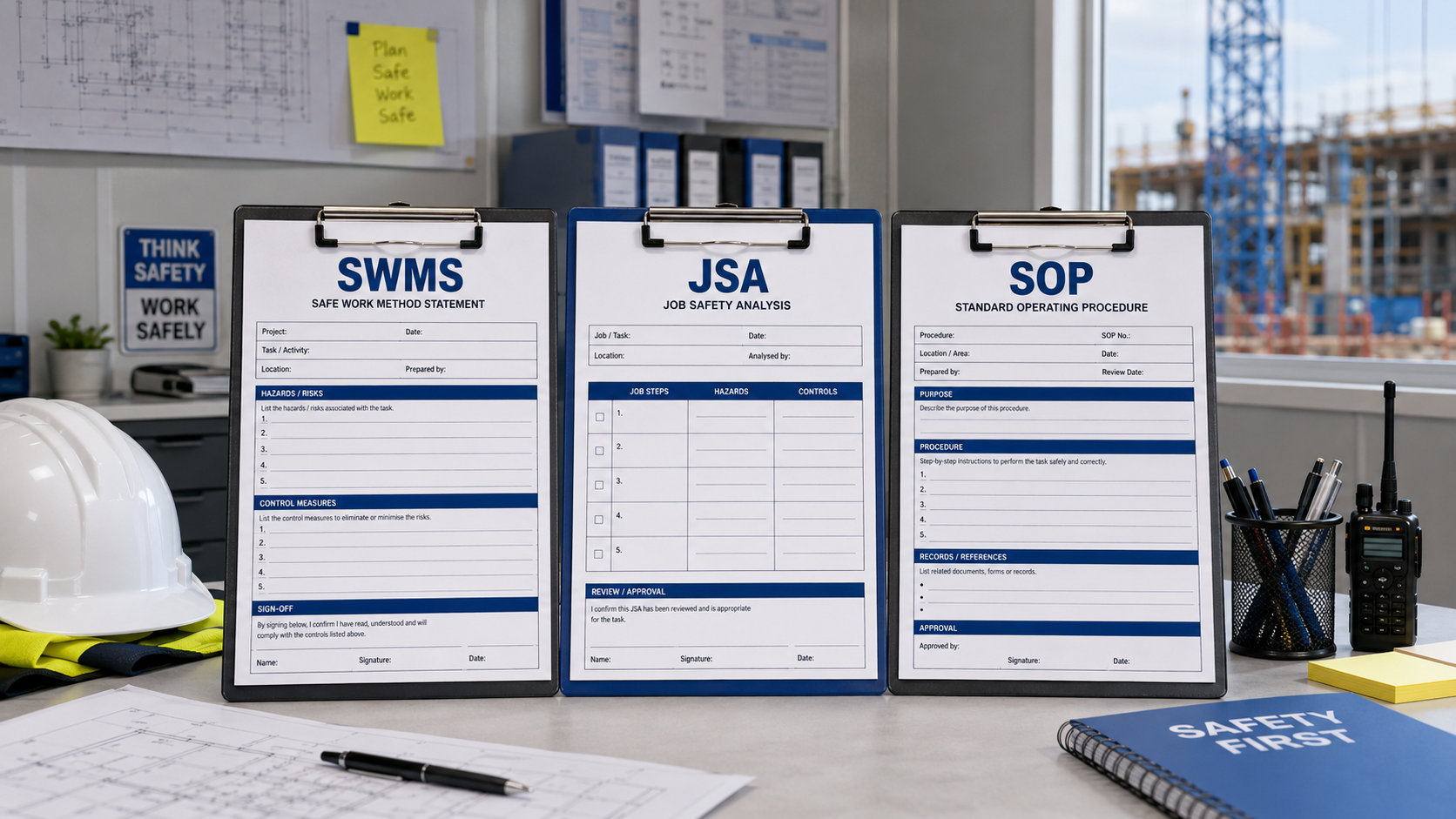
These three documents get used interchangeably on site, and that is exactly how businesses get caught out. They are not the same thing, and only one of them is required by law. Here is the difference in plain English.
The short version
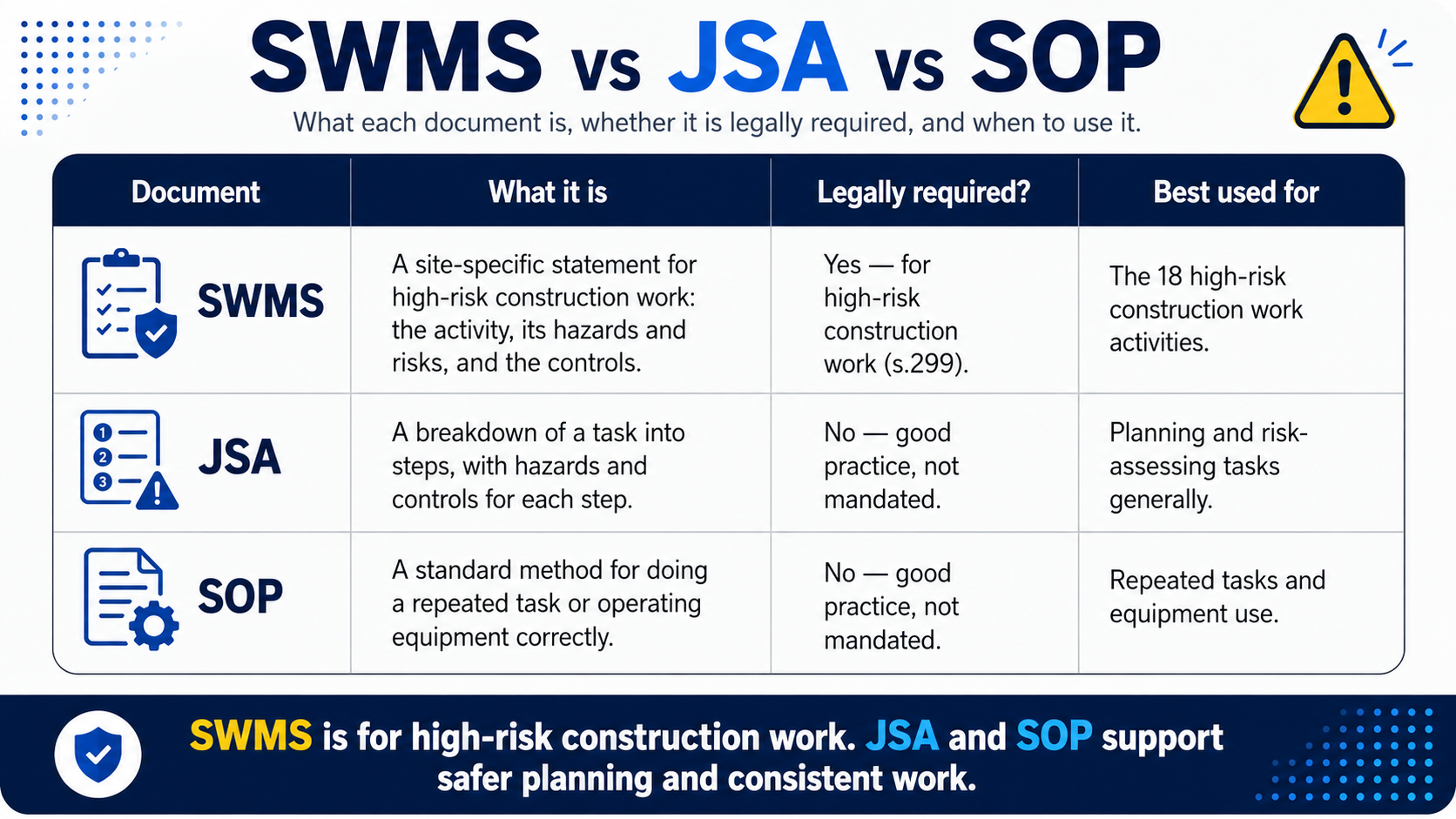
A SWMS is the only one of the three that the law specifically mandates, and only for high-risk construction work. A JSA and an SOP are good-practice tools you choose to use — useful, often valuable, but not legally required in their own right.
SWMS — Safe Work Method Statement
A SWMS is a site-specific document for high-risk construction work. It sets out the activity, the hazards and risks, the controls, and how those controls are implemented, monitored and reviewed. Under s.299 of the Work Health and Safety Regulation 2011 (Qld), it must be prepared before the work starts. It is classed as an administrative control — a tool to support higher-order controls, not a substitute for them.
Check out our article “The 18 High-Risk Construction Work Activities in Queensland” for mor information.
JSA — Job Safety Analysis
A JSA (sometimes a JSEA) breaks a task into steps, identifies the hazards at each step, and sets the controls. It is a flexible planning tool that works for almost any task, high-risk or not. It is not a legal requirement, but it is one of the most useful risk-assessment habits a crew can build.
SOP — Safe Operating Procedure
An SOP describes the correct, standard method for a repeated task or for operating a piece of equipment. It is about consistency — doing the same job the same safe way every time. Common for plant, machinery and routine workshop tasks.
Where people get it wrong
The big mistake is treating a JSA as a substitute for a SWMS on high-risk construction work. A JSA may support the planning, but if the task is one of the 18 high-risk activities, a compliant SWMS is still required. The reverse trap is producing a SWMS for everything — which buries the genuinely high-risk work under paperwork no one reads.
In practice, the documents work together. A JSA can feed the thinking behind a SWMS, and an SOP can sit underneath both for the equipment involved. The skill is knowing which one the work actually requires.
Check out our article“Do I Need a SWMS? A Simple Decision Guide” for mor information.
Sources and further reading
Work Health and Safety Regulation 2011 (Qld) — https://www.legislation.qld.gov.au/view/html/inforce/current/sl-2011-0240
WorkSafe Queensland – Safe work method statements — https://www.worksafe.qld.gov.au/resources/guides/safe-work-method-statements
Safe Work Australia – SWMS for high risk construction work (information sheet) — https://www.safeworkaustralia.gov.au/resources-and-publications/guidance-materials/safe-work-method-statement-high-risk-construction-work-information-sheet
Need help with your SWMS?
Squire Safety Consultants helps Queensland businesses with SWMS development, WHS documentation, safety management systems and practical workplace safety support — clear, compliant and usable documents that workers will actually follow.
If you would like help getting your SWMS right, get in touch Here
Need a template as a staring point? pick up a Free SWMS Template Here