
How to Write a SWMS: A Step-by-Step Guide for Queensland Sites
A good SWMS is written for the people doing the work, not for the auditor or the client. The best ones are clear, specific and short enough that a worker will actually read them. Here is the process I use.

Before you write: what the SWMS must contain
Under s.299 of the Work Health and Safety Regulation 2011 (Qld), a SWMS for high-risk construction work must:
identify the work that is high-risk construction work
specify the hazards relating to that work and the risks to health and safety
describe the control measures to be implemented
describe how those control measures will be implemented, monitored and reviewed.
It must also be prepared taking into account the circumstances at the workplace, and on a construction project, the WHS management plan. WorkSafe Queensland sets out the supporting details a SWMS should include — PCBU name, address and ABN, the person responsible for implementation and monitoring, and (on a project) the principal contractor and site address.
The step-by-step process
Walk the job first. Before writing anything, look at the actual task, the site and the conditions. A SWMS written from a desk rarely reflects reality.
Confirm the high-risk category. Identify which of the 18 high-risk construction work activities applies. This anchors the whole document.
Break the work into logical steps. Sequence the task into clear stages. Not fine detail, but enough that each part can be assessed for hazards.
Identify the real hazards. For each step, list what could actually harm someone — fall from height, contact with overhead powerlines, trench collapse, plant striking a worker. Avoid vague phrases like “general site hazards” unless you explain what they are.
Assess and select controls using the hierarchy. Work down from elimination, to substitution, isolation and engineering controls, before relying on administrative controls and PPE. A SWMS is itself an administrative control — it supports higher-order controls, it does not replace them.
Make every control specific. This is where most SWMS fail. The control must tell the worker exactly what to do, with no decision left to them.
Set out how controls will be monitored and reviewed. Name the mechanism — supervisor inspections, pre-start checks, toolbox talks, task observations.
Consult and sign on. Consult the workers who will do the job, then have them sign on to confirm they understand the hazards and controls before work starts.
Check out our article “The 18 High-Risk Construction Work Activities in Queensland” for mor information.
Write controls people can follow
The regulator is blunt about this. WorkSafe Queensland states the content should give clear direction and there should be no statement that requires a decision by a supervisor or worker. Its own example is the phrase “use appropriate PPE” — which does not detail the control at all.
Instead of:
“Use appropriate PPE.”
Write:
“Workers must wear hard hats, safety glasses, gloves, steel-capped boots and high-visibility clothing while inside the work zone.”
A workable SWMS template structure
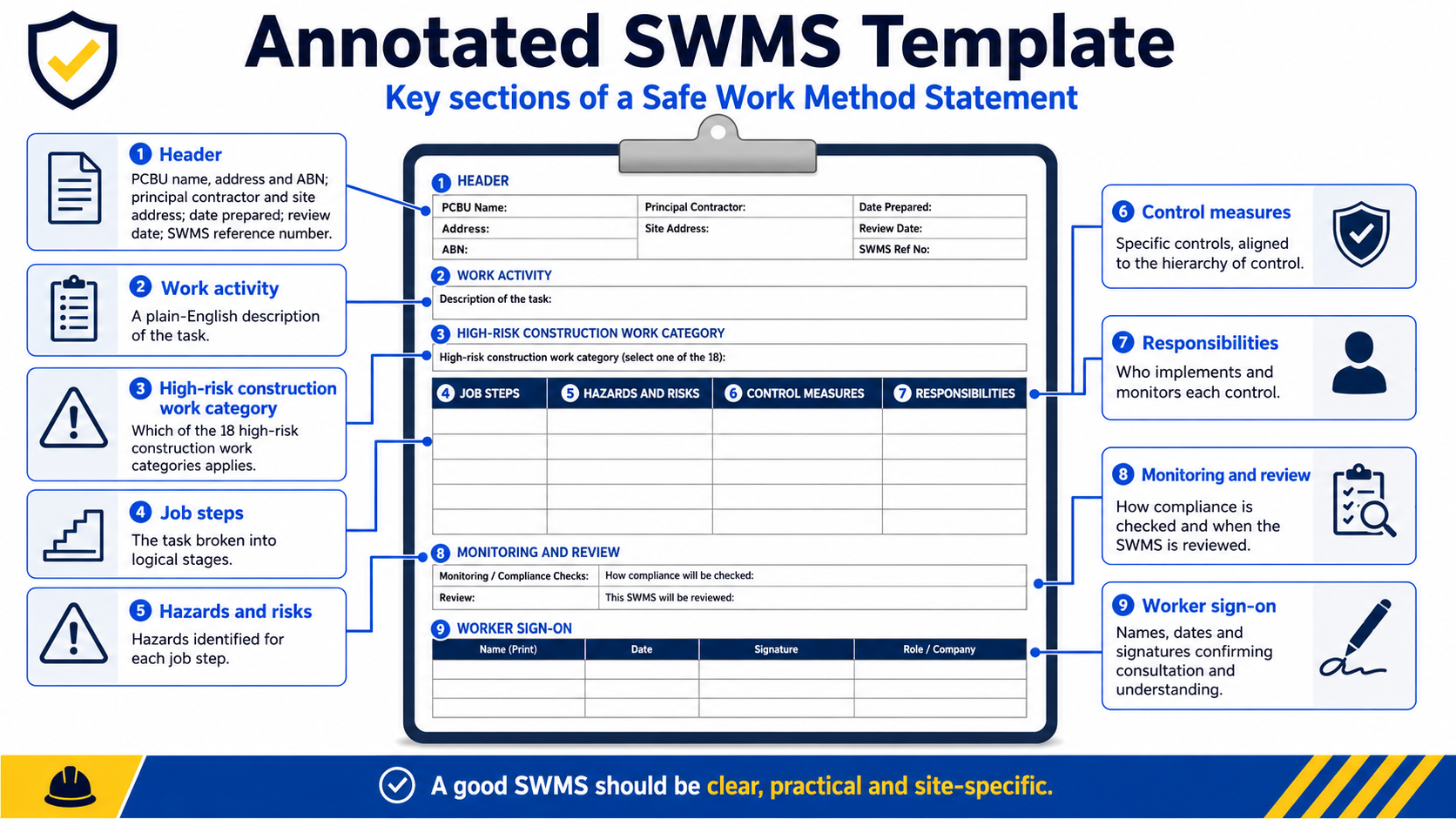
A practical SWMS for high-risk construction work generally runs in this order. Use it as a skeleton and make every field specific to the job:
Header: PCBU name, address and ABN; principal contractor and site address (on a project); date prepared; review date; SWMS reference number.
Work activity: a plain-English description of the task.
High-risk construction work category: which of the 18 applies.
Job steps: the task broken into logical stages.
Hazards and risks: for each step.
Control measures: specific, against the hierarchy of control.
Responsibilities: who implements and monitors each control.
Monitoring and review: how compliance is checked and when the SWMS is reviewed.
Worker sign-on: names, dates and signatures confirming consultation and understanding.
Keep it focused. A long, over-detailed SWMS is hard to use, monitor and review — and a SWMS no one reads is not controlling anything.
Keep it, review it, use it
Have it available on site and work in accordance with it.
If the work is not being done in accordance with the SWMS, stop until it can be.
Review and revise whenever the method or conditions change.
Keep it until the work is complete — and if a notifiable incident occurs in relation to the work, keep it for at least 2 years (per WorkSafe Queensland).
Check out our article “8 Reasons Your SWMS Would Fail an Audit” for mor information.
Sources and further reading
Work Health and Safety Regulation 2011 (Qld) — https://www.legislation.qld.gov.au/view/html/inforce/current/sl-2011-0240
WorkSafe Queensland – Safe work method statements — https://www.worksafe.qld.gov.au/resources/guides/safe-work-method-statements
Safe Work Australia – SWMS for high risk construction work (information sheet) — https://www.safeworkaustralia.gov.au/resources-and-publications/guidance-materials/safe-work-method-statement-high-risk-construction-work-information-sheet
Safe Work Australia – Model Code of Practice: Construction work — https://www.safeworkaustralia.gov.au/doc/model-code-practice-construction-work
Need help with your SWMS?
Squire Safety Consultants helps Queensland businesses with SWMS development, WHS documentation, safety management systems and practical workplace safety support — clear, compliant and usable documents that workers will actually follow.
If you would like help getting your SWMS right, get in touch Here
Need a template as a staring point? pick up a Free SWMS Template Here